Tuesday, December 1, 2009

Monica Bhatia - Feedback


Robert Kirkbride = Mission of project is unclear, make a point of saying that I am working w/ the physcologists at NYU that study the emotional brain
What keeps you up at night?
How people already deal with fear? Avoidance


Alan Wexler = look at mexican worry dolls and the day of the dead, fear lifesavers - place them in a supermarket, "candy as medicine", objects that force you to deal with it, stream of conciousness diagram of placebos, religion - aleaviating fear through prayer, broaden my scope even more, "the most powerfull anti-septic is sunlight


Seth Nagelberg = Think about fears specifically among mothers
If I were to focus specifically on swine flu - what could I make?
Can imagine candy to be something you give to a child to help them w/ fear


Mike Boylan (Designer - Harry Allen) = Look up charts of irrational fears: ways most likely to die at certain ages,
Look at the objects people are actually using to deal w/ their fears.
Need more information on board


Bart Haney (Project Manager - Fuseproject) = Shapes need to have more of a reason
Target a specific fear
Joseph LeDoux (Center for Neural Science - NYU) = How to make people WANT to use these
How do Doctors make patients less fearfull...and more fearfull?

Tom O Hare = Look at fear rituals peoples mothers did,
The history of hand soap,
There are many different reasons for having the same fears - ask people not only what they are afraid of but WHY they think they are afraid of.

Ray Koh + Friend = FEAR is False Evidence Appearing Real,
"Lick my fears" manipulate the candy material more,
Am I really talking about innocultion? I need to make that more clear if so
Adult Pacifier


Len Mayer = Look at insecurity - brands you have: stigma, coward, hiding.
The epidemic - old, dark, new , foreign.
Find people who claim not to fear, is it true?
Very important issue to address today - possibly target from more of a political angle

Elizabeth Rosenthall (Allergy Dr) = Look at National Institute of Health
Center for Disease Control
NYT Board of Health
Fear from 70s vaccinations
The Scientific Mind from Scientific America - why we make bad deisions


Jay Schiffman (Thinkativity Toys) = Need to focus on ONE thing now
brainstorm about creating products for the hypochondriac
Fear calculator - a visual way of expressing risk statistics, such as a jar of m & ms that makes you find the one candy in the jar that is the likeliness that something bad will happen to you
A landfill of worry to recycling your fears
A clock that shows you how much time is wasted by worry
Fear breathalizer - won't let you use the internet or start your car
Bio-feedback

Elias Kulukundis_board and feedback

Feedback:

Jennifer Carpenter:

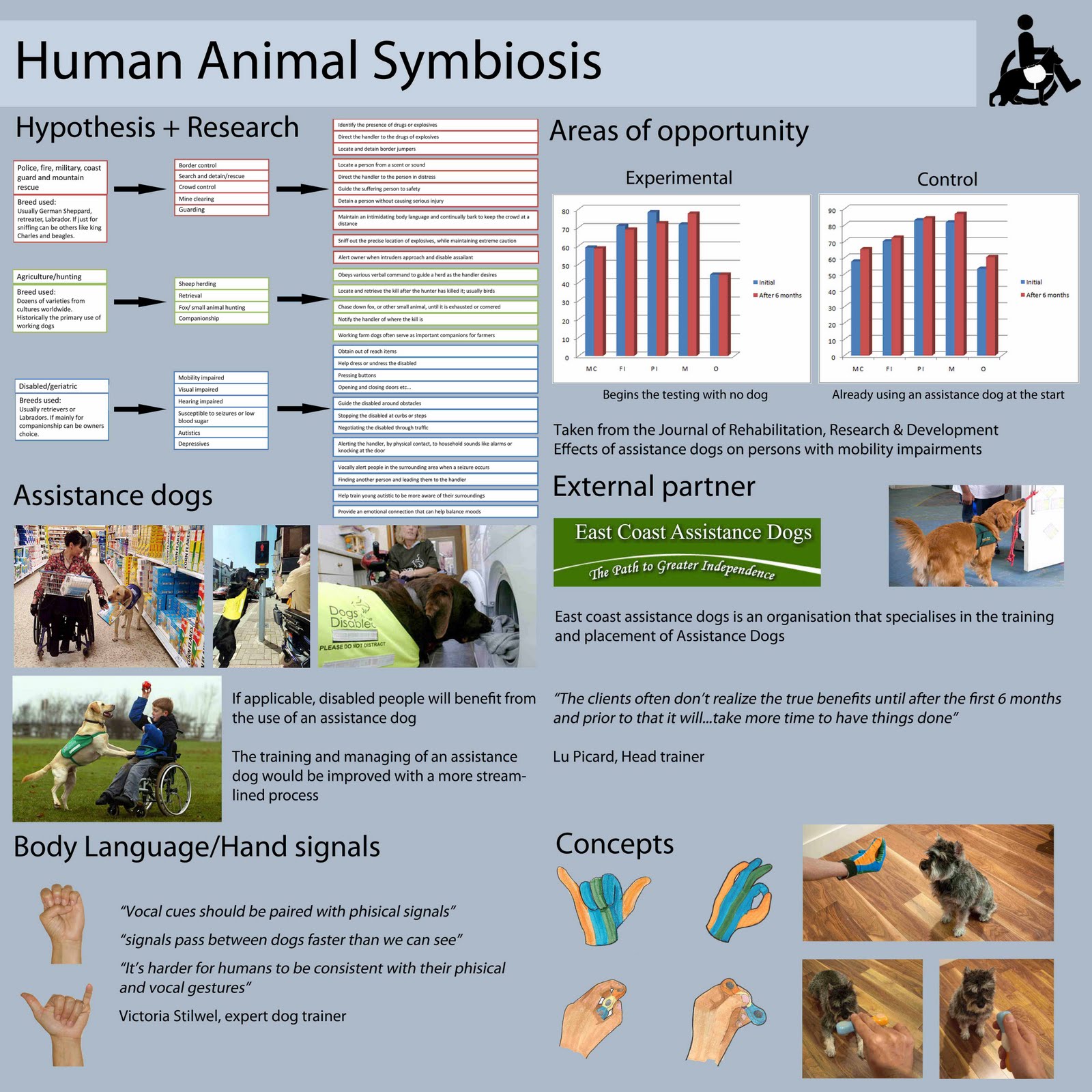
  • Keep the eventual project lo-tech, like the glove concept
  • Use the glove concept to teach the handler to be more consistent; using the glove to force each hand position
  • Go more towards a more exaggerated series of signals; possible a large prosthetic to aid in signalling during training

Anna Rabinowits:

  • Find out about prisoner training programmes for assistance dogs
  • Aim to bring the bring the project in a full circle by rehabilitating the disabled through the rehabilitation of prisoners
  • Obtain more info and quotes from Lu Picard at ECAD Supporting my argument
  • Specify my eventual concept as a universal language between humans and dogs

Rick Penny:

  • Contact experts on sign language to get a background on humans using sign
  • Focus on the idea of training the person as opposed to the dog
  • The eventual product could be a communication tool, accompanied by a book or dictionary of the language

Marc Bechtel:

  • Go to ECAD to watch the process of training and rehabilitation
  • Attempt to contact more people with disabilities and assistance dog users
  • Go forward with a more subtle concept like the glove

JAKE SHAPIRO: Mid Year review


Eddie- interest in death meditation
John Gendal - interference of existing traditions
Tom - The importance of the graveyard

HS Thesis on 11/30


+INTRO

"All of Earth's oxygen is produced by photosynthesis, the process plants use to combine water and carbon dioxide to create glucose (their own food) and oxygen."

Because of our bad habitual behaviors, including the extreme consumerism, our natural resources are decreasing, and environment pollution is increasing dramatically. It causes greenhouse effect, global warming, sea level rise, and many human illnesses due to the damage of the respiratory organs and immune system.

Out of many proposals, planting tree is one of the most cost-effective ways to capitalize on the natural services provided by healthy ecosystems. Trees do so many things; purifying air, stopping flood, controlling the temperature, absorbing bad chemicals and compost, and also providing fruits. Trees can absorb carbon and reduce greenhouse effect, global warming, and also sea level rise.

Thus, we need to save our trees and plant more trees.


+MISSION

My goal is to provide people with a better understanding of how trees interact with our urban environment; how our urban forest provides us with cleaner air, a cooler city and a thriving wildlife; and how trees can make a real difference in creating a more sustainable city.

+DESIGN OPPORTUNITY

People tend to ignore big problems that they can’t solve by themselves. We do not know how and where to plant trees. We also do not know how to take care of trees for more than 15 years, especially in Urban Area.

I want to approach this matter by providing people the enjoyable tree activity. Because I believe that it will create the synergistic acts carried out by many people to begin to have the positive outcomes on a large scale to solve the problem.

+CONCEPT

Tree house: Tree houses inspire such joy and childlike wonder. Many of us dreamed about living in a tree house or at least having a tree house in the backyard in our childhood. It is not easy to make a tree house for everyone, because the design and functions depend on the trees, which are all different shapes and sizes. I want to design a tree house that can be prefabricated, so it makes it easy to pack, ship, assemble, and remove for anyone.

Tree tent: Urban people have a craving for the nature. They are tired of being in the polluted area. I want to design a tree tent for them to experience the nature easier. It will be made out of recycled PET fabric. Homeless can also get the tent by planting certain amount of trees and collecting PET bottles.

Tree wall: There are about 200 different plant species that can grow on walls. There will be some kind of structure that can be installed on to the individual house’s windows. The structure will help plants to grow on the building walls. The goal is to make green buildings as many as possible. Plants can save a lot of energy. Just three trees planted around the average size home can lower air-conditioning bills by up to 50%, and trees that shield homes against the wind can lower heating bills by up to 30%. An average tree absorbs ten pounds of pollutants from the air each year, including four pounds of ozone and three pounds of particulates.


FEEDBACK

Tree house: It really should be for anyone. Study joints and hinges from Japanese and Korean architecture. Study materials.

Use no glue and screws.

Tree tent: Research other alternative recyclable or reusable materials. Design it to be installed only on trees. Study the regulations. Make it strong.

Tree wall: Study the plant growing system. Worried about insects. Enhance the ecological food chain.

Yoomi Choi board and feedback


Feedbacks from Dennis Derek, Jennifer Carpenter, Sofia Kim, Emily Day, Hiro Kato, Barnette Coscia, Richard Yeh

- What are the problems with children, without mothers?
- Find more about the programs for children
- Material exploration
- Narrow down the target age of the children
- What happens after mothers are released?
- Think of the process from prison to foster care to children
- Design the whole system of how the product is going to work (how is it different from existing frames?)
- Set up the foundation, mission statement
- Exact number of mothers returning to prison?

Ga-Ram Han // Review & Feedback


Feedback from:

Hiro & Richard -
Look into teen behavior
Incorporate education into design
Look at universal design language
Consider ergonomics

Mark Bechtel -
Look past age group, teens are very smart
More sophisticated a lock, better it is compromised
Internet creates knowledge
Simple is better

Emily Day (Psychology Candidate) -
Get in contact with psychology professor
Look into different behaviors
See how lifestyle affects behavior
Parents are in denial of issue
Any way to know if kids are attempting to take pills from parent?

Len Mayor -
Look at how the meds are prescribed
Notice rituals of taking meds, who are these people?
How can these pills be DISPENSED?
Who is now RESPONSIBLE?
Look into different methods of dispensing

Sophia & Baron -
See how teens take meds in school
How can parents monitor use?
Look at different means of detecting, such as
black lights, polished bottles, easy to fingerprint?

Kevin Jean & Dilip Sidhu -
Why are current treatments not working?
Look at how certain treatments do work
How can these caps be standardized?

Robert Kirkbride -
Teenagers are naturally curious
They fail to see that something can be bad
Dealing with shortage of experience
Relate to teenager, taking drugs are dumb
Talk to Ted Bifield (Communication Design)

Lauren Rossi: Updates


Jennifer

- Clearly state the three reasons why women are not wearing these bras and why women should be wearing these bras
- Use the tags you created as conversation starters
- Leave out your process if it does not strengthen your argument. EX. “At first I thought physical healing would effect….” To “physical and psychological healing effect one another”

William

- Look at Nike materials and style, it could be a source of inspiration for your project
- You are looking at comfort and attractiveness
- Material exploration will be very important – must be washable
- Ace bandages will not hold up – scrap the idea
- Speak to a large range of survivors, they will be more open


Emily Day

- Psychology representative (talk to Robert if you want to pair up with other students)
- You speak very comfortably/sensitively about the subject
- Great idea

Caressa

- Confusion that I may be focusing on “style” I may really need to put an emphasis on physical healing
o There are many types of women, lots of styles, need a different style for each women: I might want to pick a style group or “persona” for example I may want to look at a young women in a relationship – what tpe of healing garment would they want?
o The white models are confusing, they look so bland – not beautiful
o It is so similar to the last project “Chikara” – it will be hard to live up to – she was thinking about doing her thesis on breast cancer – but didn’t want to live up to that project - but feels I have the potential to make this a great project
- if you want to talk to women, talk to survivors
- how many women have breast cancer?
- Need to narrow in on a smaller focus
- Focus on moment where you could have the biggest impact
- Think about creating a collection (about three)
- It would be wonderful if you could follow someone post surgery

Roberto Fantauzzi 11/30 Thesis Review

Thesis Review Comments & Feedback

Grace Tsai

  • Felt hypothesis needs to be redirected to improving communication between parents and children.
  • The material and environmental growth aspect of the project are secondary and were distracting to her at this stage in the thesis year.

Jennifer Carpenter

  • State in problem graphical proof based on surveys.
  • Use photography of my actual case studies
  • Tweak hypothesis, problem and proposal based on discussion and rearrange order on board.
  • Further development on packaging as an element of the product.

Kerry McNaughton

  • Study planetariums and the process of dying plants and how it becomes alive.
  • Study the Amazing Message Plants – plants that grow to reveal a message in the leaves (http://www.message-plant.com).
  • Research natural plant pigments for packaging
  • Bright colors for packaging.
  • Enjoyed the poetry of the emotional, material and environmental re-birth and how it connects to each other

Robert Kirkbride

  • Felt the hypothesis and proposal should be geared towards the child independent of the parent; with an added incentive of incorporating parent/child communication.
  • Packaging experience for children – explore how children like to open packages.
  • Think of how child will use the artifact after healing process – becoming a talisman for personal use to put things inside.
  • Further exploration of the body of the artifact and how children will react to it (face, head, brain, body, legs, chest).
  • Further exploration of form with regard to relationship of water and human relationship.
  • Adding color to the wood.
  • Think of standardizing certain features of the artifacts so that the family of toys and their different parts can be switched and screwed onto different bodies.

Mark Bechtel

  • Study art therapy programs.
  • Careful on how I present the environmental impact of how the artifact is created.

unedited video clips from last night's review


Sun Ki Jeon - Mid Review


Feedback:

Kevin Jean
Emphasize the price of the bike. There's bike that cost thousands of dollars.
talk to people who actually commute with their bike, where do they park their bikes?


David Bergman
Suggest me to do outdoor parking for the bikes.
indoor parking will cause a lot of problems. People will have hard time taking it to their office once the law starts.

Len Mayor
Get real. will this work? Research on what commercial buildings are like in NYC. Will there be enough space for bicycle in the office? What is the environment like in common office in NYC? Where will people store their bikes?

Steven Landau
Good topic but think of variety way, not just parking for the bikes. There are more opportunities for the product designer other than indoor parking.

Edwin Torres
Interesting topic but hard to come up with the solution.

Seth Nagelberg
How are people going to take their bike to their office? There will be a lot of process taking their bike. How about creating a Bike garage?


Feed backs from: Toshi, Zane, Tom, Richard, Thomas, Jennifer, Erika, Joe.

- Image has to be more powerful (either it's shocking or relates to people's memory)
Image may need more of sarcasm/exaggeration
Has to be Universal(appeal to every ages)
- better to see research/ facts (a rates of accidents, compare with other subways)
- Look at pictograms/ Ideogram
- Look at a products that sell with an awareness
(ex. LIVE STRONG arm band, what triggers people to voluntarily buy them)
- May have to work on objects (doors, chairs, etc)
- Interview people whom responded to those images in the subway

Violaine de Pourtales
Feedback from Mid Review

Person 1:
I am looking to offer a line of furniture that is of high quality and flexible or multifunctional for people who can afford it. My designs for now are too conservative or timid and that i need to think more of what is my ideal. The person explained what is heirloom furniture. My design will need to be super efficient.

Person 2:
Have to consider crumbs and spills when you are using the dinning table to make sure that nothing gets on the work on the desk. Should consider materials carefully, should be light weight to make it easier when moving homes. I should think about the movement of people in an apartment, and reflect that movement in my design of my dinning table/ desk. To think how the form of my table can dictate the movement of the people. I should think about how it can unfold or change from dinning table to desk and to get inspired by nature, how flowers open and close, to look at animals as well. My design has to be well made and for it to last it needs to have the criteria of durability and comfort.

Person 3:
For my furniture to be heirloom it will need strong joints, mortis and tenons, it will need to be solid with strong wood like ash, maple or walnut. I need to look at shakers furniture and the encyclopedia of furniture. My furniture will need to be classic, strong and modern for it to last. Something simple and calm.

Person 4:
Look at japanese design how their furniture is built and also how they move it and use it. They don't use as many furniture as americans does for example, they use less and therefore it is easier to move around and move homes. I need to design something that is of today about the specific time of today and so to think about sustainability. I need to look at furniture that has nesting. Finally i should think about how in one piece of furniture i can have the most about of surface space possible.

Person 5:
I need to look at companies who produce products to last like L&L bean or any company that makes products that are meant to last or be passed down. I should research how these companies started and why. Perhaps i can think of the after service of my furniture, if a leg is damaged for example, there can be a service that fixes it. Components can be replaced or fixed.
I need to look at how people sit around a table in different countries, if i am think of big cities like new york city and other big cities like in japan for example, people sit differently around a table. Lastly, i should research how many multifunctional furniture does well today.

Person 6:
That i am tackling too much, i should focus on either the multifunctional aspect or the lasting aspect, that it is too much to do both. There is enough to figure out in a piece of furniture that wants to do two things and that in most cases multifunctional furniture doesn't do both things well, that is only does one thing well and that people are to lazy or never end up transforming or changing the piece of furniture. However lack of living space is a problem and what i am seeking to do with the dinning table and desk is a good approach and that i should focus on that and not the lasting aspect of it. Today people don't buy furniture that is expensive because it is made of good materials like hardwood and people don't really think of passing it down to future generations or fewer people than 50 years ago. People make less money today than before and i should take that into consideration.

Conclusion:
All people i spoke to were interested by my focus and likes the multifunctional aspect and lasting aspect however the multifunctional aspect was the clearest to people and most people saw it as my primary concern, in addition people said it can be lasting if it is well built and with good materials. I want to continue working on my dinning table / desk idea and want to keep in mind the lasting aspect of it but perhaps my main focus is not for my furniture to be heirloom, perhaps it will still end up being heirloom because i want to use strong materials. My target audience is people who can afford it, who wants well built furniture that doesn't break down easily. I will create multifunctional furniture, to help the problem of tight living space and to make it easier when moving homes because there will be less furniture to move.

photos from the review on November 30, 2009


2009-11-30-2300-56

David Lee Mid-Year Review - Board & Feedback


Feedback

1. Tom O'Hare
  • "I had giant tinkertoys when I was a kid and I loved them."
  • Idea: use PVC pipes, just create joints and accessories to go along with them.
  • How and where is it used (home or school) this will guide some design decisions
  • Look into after school programs. Tom worked with High School of Computers and Technology in the Bronx
  • Find existing curriculum to modify
  • Try out a range of complexity for each idea (simple<-->complex)
2. Anna Rabinowitz & Associate
  • Most important things to consider are SCALE & IMPACT
  • Visit Harlem's Children's Museum
  • See movie called "The Best School in the World"
  • Make sure product is "ungendered" to balance inequalities and get girls into science
  • If seeking early age for greater impact working even younger like 3 yrs old may be appropriate
3. Len Mayor
  • At what age group are interest solidified?
  • Are these tools too demanding for children? It it a lot of work to make just simple things
  • Instead try including premade parts to use with custom made things
  • Consider the middle ground between my 2 design strategies.
  • Balance these factors: impetus, catalyst, quiet assistance
  • Should be abstract and not recognizable like a bike to allow kids to create their own forms
  • Are vehicles gender biased or gender neutral?
4. Erica Doering (Materials 4 Professor)
  • Science is taught in kindergarten, see what and how it is taught.
  • How can the products grow with kids to maintain interest in the toy and allow for growing minds and bodies
  • Emphasize the play aspects
  • What are the causes of declining interest

5. PJ Carlino (Materials 4 & Thesis Prototyping Professor)
  • Study what and how upper level students learn and simplify for younger age group
  • Integrate the making of simple parts to use WITH existing products
  • Explore other construction opportunities outside of vehicles
6. David Bergman (Materials & Sustainability Professor)
  • Consult Material Connection for sustainable material substitutes for Blue Foam
7. Zane (Product Design Jr)
  • Use cheap material to build out of, or reusable like playdough, or make you own building materials
HIGHLIGHTS
  1. Experiment with varying degrees of complexity (simple<-->complex)
  2. Blend 2 design strategies to find a middle ground
  3. Reference Kindergarten or older students science curriculum and teaching methods
  4. Combine creation of parts from scratch with pre-made parts
  5. Building materials? Make your own? Material Connection?

Evanee Wu- Mid Review Feedback

Today I talked to: PJ, Steven, Grace, Richard, Vanessa, Kim

Feedbacks:
-Quince has a historical reference(thinking about Shakespeare), yet try to think about how you can utilize technology. How can technology help you market/educate the foods.
-Think about ways to distribute foods.
-Making quince to a pie? It may be a cultural food as an apple pie is.
-Look beyond taste. How do these foods attract people other than food lovers? How do you engage people who does not cook?
-Foods are experiential. Look at how people know about foods? It may be from TV shows, dining experiences, friends, family, Ads, etc.
-The board is a little bit misleading by putting the big targeted frame and the case study together. It seems like two projects on a board.

Home Fat Home by Amanda Huffingham

Rob Spalding


Last night, I spoke to:
Rick Penney:
-board is vibrant
-info graphic hard to read but valuable info (once you explain it)

Charlene Lyu:
-make it a non-issue (are you hiding us?)
-who is the user of your product (homo, hetero, both?)

Kerry McNaughton:
-heterosexual relationships are also breaking down (gender roles)
-courting/dating in general
-image of 1950s gender roles irritating to deal with
-"FACILITATING"
-urban vs. rural
-use sustainability as a model
-"zinger to the brain"
-how do you say "I want to spend time with you" ?

Roberto Fantauzzi:
-photographs of sculptures (male/female --> male/male)
-ad campaigns
-editorial (fashion photography)

Eddie Torres:
-cultural vs. religious jews
-diffusion of conflict (leads to non-issue)
-"drawing your fish in the sand" (Christian story)
-"membership" in a club
-today's CHOICE (big box stores, sexuality, etc.)
-"CURATE"
-contact Jen Rhee for her point of view (media studies)
-story about Salt Lake City bar (gays are the only ones having brunch because everyone else is at temple)

DISCUSSION:
Karen Tinney:
-"merger" product
-genderless, sexless object

Vanessa Lyung:
-parents' role in raising a child?

Rick Penney:
-neutralizing roles
-next stage in EVOLUTION?
-disasters/horrible sexual experiences (regarding different preferences)
-take a position (political?)

Karen Tinney:
-why stereotypes and when?

Rick Penney:
-do we play roles? (are we actors?)
-inclusive area of human life vs. gender life
:END DISCUSSION

Lisa Berkeley:
-sexual initiation
-friend is working on "Initiation Opera"
(gave me contact info of friend)

Ray Koh:
-"i know what you're doing"
-provocative
-you've got the idea: just do the work
-idea is most important

Kevin Jean:
-are you designing for the PRESENT or the FUTURE?
-anonymous
-watch: INFOMANIA on Current TV: "that's so gay"
-could you design an ad campaign?
-references: H&M skirt for guys, pitching tights to guys
-homogeneous society

Steven Landau:
-what does declining birth rate have to do with this project? (less hetero sex)
-womens' desire?
-accept children will eventually have sex (provocative)
-animal instinct

IN GENERAL:
-send similar survey to heterosexuals
-bring everyone down to "the sex act"
-what does it mean to raise a child as a child vs. a child who will eventually be married? In other words, the child's life leading up to puberty has no expectations. Then the child is supposed to use puberty to find out who/what he/she is attracted to.

Feedback

Eddie Toures: Look at indigineous foods to Hispanic people vs. American- cultural translation, Why would a meal work in Puerto Rico and not here?
Richard (Graduate of 2009): serving size- daily calorie- advertising- cultural significance of advertising translating- from tv, to toy, to food.
Dr. Judy Wylie Rossett- Problems: children packing lunch but eating it before lunch,  Parent or older sibling picks the child up from school, shopping and planning vs. impulse, parentalizing as method of power and control over food, supermarket set-up impulse vs. produce isle, blame game, communication, cultural openess, goals
Melinda Wax: Problems sitting and eating vs. eating on the run, Napen Kohen-look up
Detroit MacAuthor Grant
Dennis Daerrycir- Food Price vs. value, milk-hormones, four distributors control NYC food, schools serve 700,000, Food Security= Structural Racism- 1. accessibility(walking) 2. Affordability 3. Cultural Identity (Pathmark selling plantans)
Community owned, mapping out resources, 
Hiro- more detail on mental models - get more specific
Kevin McElroy- changing behavior- emotional connection + convenience, money spent at bodegas, codes- preconcieved class barriers, Food- more interaction
Rick Penny-potpurri of ethnic attitudes surrounding food- further delve into area of interest, Forced consumption- eating constructively with food stamps, games- play kitchen, home economics- still exists?d
Steven-motivation as a simple society change, emotional connection- how does the shopping trip work- hone in the home.
Tom McKay- How could two different perceptions be geared in the same direction, Aligning- understanding what their interests are Obesity is a result of no exercise- you have to start early- children won't eat what they haven't had before + making kids watch Supersize me, Popeye ate spinach so children will eat spinach, Food understanding- what food does- break it down for kids, Boston PBS- cultural make up


Grace:

--Try to avoid working with the govt b/c I did & it was very difficult & not fun
--Not everyone will be able to accept your concept so think about that & be convinving
--The wearable money seems like an interesting solution to your problem b/c it doesn't involve people altering their internal body.

Tom

--Very interesting concept from a practical design level
--Think about unique ways that you can deactivate the identity
--Do you program it? Does someone program it for you? Are you in complete control of your identity?
--risky unless you're 100% in control
--series cards. Do they include money? Social security? Medical records? & if so, is that safe to carry around?
--As for wearable money, it's camouflage but the camouflage ends when people see you using it.
--could it deactivate when moved a certain distance?

Steven

--All info could be stored on the microchip
--incorporating objects bridges the gap between the the completely futuristic digital world and gives your project a lot of reality
--think about how the data is backed up of there's a glitch
--provides a sense of physical security
--passive & active project
--analogue & digital hybrid!
--Fail safe feature when systems go down??
--How do you make it tangible?

Tom O'Hare
--people are scared of this kind of thing. How can you target that?
--great fix, but could it be erased/deleted just as easily?
--RFID Passports
--Copying
--prevention: metal case
--education about storage/discarding


William & Jennifer

--Will: Chip inside is scary
--idea of becoming an object of a corporation: Visa owns me?
--Social Identity
--Implant
--deal w/ surveillance
--why this is different
--you can deactivate it
--design:
--medical tool
--about security
--streamlining
--can in be inserted and removed>
--can you change what it does/stores on your own?

Otto

--Can you take it out if you don't want it anymore?
--How do you target biblical aspects
--my body is sacred & I don't want anything in it & I don't wear jewelry so how
does this affect me?
--"Give me your card!"
--if I knew it was a 2-part object, would I not ask for the deactivator?
--how do you target that?
--Definitely a cool concept: don't let anyone discourage your process. Prove them
wrong.

Ray Koh

--Scrambler
--if some tries to take it, the info can scramble
--compatible only w/ the rightful owner
--could incorporate a series of objects for those skeptical of the body
--sustainable concept
--very cool


Me


I was little surprised at how many people reacted in such a positive way. I expected a little more "You're crazy!" but a lot of people really embraced my concepts. Even those who were moderately skeptical had great feedback in explaining how to target ways that prevent it from working.

CHELSEA BRIGANTI: MID REVIEW BOARD + FEEDBACK


FEEDBACK:

ANNA RABINOWICZ: professor, product design
-what is the relationship between cancer and stem cells?
-How do stem cells regrow things?
-missing a direct connection between stem cells and heart disease
-when we think of stem cells, we don't think of the heart, why?
-talk about what is going on in stem cell research right now
-my project is moving too much toward awareness
-can my heart scan watch product function technically, how?
-talk about biofeedback more

DENNIS: milano project
-he was amazed that more people don't talk about menstrual blood and stem cells
-how will my project end up as a product design?

JENNY:CD student
-maybe the user would wear only certain parts of the ring to symbolize damaged areas of the heart
-the heart scan watch is interesting-but it needs to be more private

LAWRENCE: arch. student
-think about the NMRI technology: is it harmful if worn all the time?

SETH NAGELBERG:professor, ceramics
-look at female urinals in europe
-connect people more to stem cells--a bit confusing right now
-explain heart patches more in the begining--relate back to columbia

TOBIAS WONG:designer
-the heart ring is too elementary
-what's another way to connect people?
-iphones are the direction we are headed for in terms of electronics--think about this instead of a scan watch
-fashion dictates everything--make it stylish and modern
-the heart is sacred--play up this idea
-maybe not necessary to collect bottles of menstrual blood, but only a drop--since they replicate so fast
-menstrual blood is tricky--connect more why women would even want to do this
-tone down logo--maybe its too much
-love that I am not using any red---too easy and boring
-maybe change fonts up

JOSEE LEPAGE:design consultant
-it would be difficult to get women on board to collect their own menstrual blood--are these extreme people or who would be targeted for this kind of product?
-the board and products need to relate more to eachother-right now they seem separate-make that connection

TIM DUBITSKY:designer, kiehls global
-maybe too much text on my board
-look at how new york magazine conveys stats
-maybe break my project into 3 parts: awareness/prevention/connection etc. think about this
-put real images on my board: a real stem cell etc.
-make Columbia connection more prominent

JENNIFER CARPENTER:thesis professor, product design
-layout on board is good
-not sure about connections
-look at the scars of women who have had a heart operation-they are high on their chest
-there is definitely a disconnect between people and their physical self
-watch may be too expensive
-bottle idea is interesting-menstrual blood is ubiquitous, free, ties to women and awareness etc.
-look at the history of menstruation
-tweak problem to talk about a lack of connection to the "bodie's resources" i.e stem cells
-people need to understand their own stem cells
-how do we collect our own stem cells?
-packaging is important
-how can storage be cheaper for freezing stem cells?
-what are other sources of power?
-supply and demand is the key
-look at the menstrual blood bank in India
-think about pods that come directly out of your body that can be placed in freezer to preserve stem cells

MIKE BOYLAN:product designer, harry allen
-visualizing data is always best
-a wealth of new icons and manifestations are possible within my topic
-return envelop in a tampon box: could it be this simple?
-look at blood drive trucks
-stem cell patch is about administering meds----could doctors use this?
-synergize with other feminine protection companies
-think about biodegradable/ renewable packaging
-"the netflix" for menstrual stem cells---make the process convenient

BAIRON AND SOPHIA: alumni and designers
-visual feedback is important
-look at lifelines--what do they tell us?
-people really can't pinpoint their hearts
-connect stem cells to the heart more

DELIP: anesthesiologist resident, st. vincents
-NMRI watch gives off too much radiation--look to other technologies
-challenge is trying to connect to a younger population--"show them what a heart attack feels like/looks like"
-this is a very interesting topic

Len Mayer, thesis professor, product design
-why aren't I using more red?
-why isn't stem cell transplantation happening right now?
-look to policy makers---they are important stakeholders
-this is the new era of hope--everything will now be accelerated--why was it delayed?
-create more hope
-de-mysitify us!!!
-impact me more--why should I care or be excited about this?